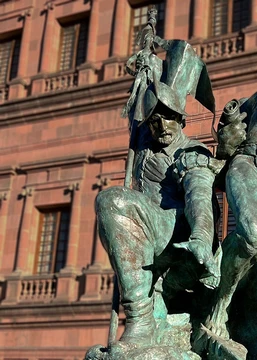
Álvar Núñez Cabeza de Vaca
Spanish explorer, survivor, and chronicler of Native American tribes.
Álvar Núñez Cabeza de Vaca was a Spanish explorer of the New World, best known as one of four survivors of the 1527 Narváez expedition. Over eight years of travel across what is today the Southwestern United States, he became a trader, evangelist, and faith healer to various Native American tribes before reconnecting with Spanish civilization in Mexico in 1536. He later served as governor in South America and wrote a detailed account of his experiences, sometimes considered a proto-anthropologist.
- born
- c. 1488/90/92
- died
- after 19 May 1559
- field
- Exploration, governance, writing
- nationality
- Spanish
- known_for
- Survivor of the Narváez expedition; author of La relación y comentarios (Naufragios y comentarios); proto-anthropologist
Lore & Background
Álvar Núñez Cabeza de Vaca was born around 1490 in Jerez de la Frontera, Cádiz, to an hidalgo family. His paternal grandfather, Pedro de Vera y Mendoza, was a military governor who conquered Grand Canaria and brutally suppressed a revolt on Gomera. Cabeza de Vaca served as a page and chamberlain to the Duke of Medina Sidonia, fought in the Italian Wars (including the Battle of Ravenna in 1512), and later fought against the Revolt of the Comuneros and the French in Navarre. In 1527 he was appointed royal treasurer for Pánfilo de Narváez's expedition to La Florida.
The expedition set sail in June 1527 with five vessels and 600 people. After losing men in Hispaniola and ships in a hurricane in Cuba, the reduced fleet reached Florida in April 1528, likely near Tampa Bay. Against Cabeza de Vaca's advice, Narváez split the expedition, leading 300 men overland toward Apalachee while the ships sailed ahead. Cabeza de Vaca joined the overland march, later writing that he preferred risking his life to placing his honor in jeopardy. After eight years of travel, he and three others were the only survivors, reaching Mexico in 1536.
After returning to Spain in 1537, he wrote La relación y comentarios (published 1542), later retitled Naufragios y comentarios. In 1540 he was appointed adelantado of what is now Paraguay, serving as governor and captain general of New Andalusia. He worked to build up Buenos Aires but was charged with poor administration in 1544, arrested, and transported to Spain for trial in 1545. His sentence was eventually commuted, but he never returned to the Americas.
Reader's Guide
Cabeza de Vaca's significance lies in his detailed written accounts of Native American tribes encountered during his eight-year journey, which have earned him the label of proto-anthropologist. His narrative, first published in 1542, provides one of the earliest European descriptions of the peoples and environments of the Southwestern United States. Unlike many conquistadors, he adopted roles as trader, evangelist, and faith healer among the tribes, reflecting a unique approach to survival and interaction. His later governorship in Paraguay ended in controversy and arrest, but his writings remain a key source for understanding early Spanish exploration and indigenous cultures. The article notes he has been portrayed as a unique explorer with a focus on expansion and faith conversion.
Did You Know?
- Cabeza de Vaca was one of only four survivors of the 1527 Narváez expedition.
- He served as a page and chamberlain to the Duke of Medina Sidonia before his explorations.
- His grandfather, Pedro de Vera, conquered Grand Canaria and sold Canary natives into slavery.
- He named a province in South America, Vera, in honor of his grandfather.
More in Explorers & Conquistadors 1-20
Spotted an error? Know more?
This is a living reference — every entry is fact-audited, and reader corrections feed straight into our audit queue. Suggest an edit · See this site's audit record