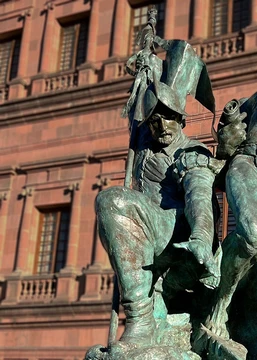
William Adams (samurai)
English navigator who became a samurai advisor in Japan.

Wikipedia / Wikimedia Commons
William Adams was born on 24 September 1564 in Gillingham, Kent, England. After his father died when he was twelve, he was apprenticed to a shipyard owner named Nicholas Diggins in Limehouse, where he spent twelve years learning shipbuilding, astronomy, and navigation. He then served in the Royal Navy under Sir Francis Drake during England’s war with Spain, acting as master of the *Richarde Dyffylde*, a resupply ship that carried ammunition and food for the English fleet during the 1588 battle against the Spanish Armada. Whether he resupplied from the rear or fought on the front line is unclear. After the victory, the Queen’s fleet was disbanded, and Adams lost his job. He later found work with the Barbary Company, and Jesuit sources claim he spent about two years on an Arctic expedition searching for a Northeast Passage along Siberia’s coast to the Far East.
In 1598, Adams was hired as chief pilot for a five-ship fleet organized by a Rotterdam merchant company (a *voorcompagnie*, a predecessor of the Dutch East India Company). The fleet’s goal was to reach the western coast of South America, trade for silver, and then—if that failed—head to Japan to obtain silver and spices in the Moluccas before returning home. The ships were the *Hoop* (lost near Hawaii), the *Liefde* (the only one to reach Japan), the *Geloof* (the only one to return to Rotterdam), the *Trouw* (captured in Tidore), and the *Blijde Boodschap* (seized in Valparaíso). The expedition left Goeree on 27 June 1598, anchored in the Downs until mid-July, and then sailed toward North Africa. Rations were cut early on, and the ships stopped at Santiago, Cape Verde, and Mayo for water and fresh fruit, staying about three weeks. Near Praia, they briefly occupied a Portuguese castle but gained nothing substantial. At Brava, half the crew of the *Hoop* fell ill with fever, and Admiral Jacques Mahu died. Leadership passed to Simon de Cordes, with Gerrit van Beuningen as vice admiral. Contrary winds then blew the fleet off course.
Adams arrived in Japan in 1600 as one of the few survivors of the *Liefde*, under Jacob Quaeckernaeck. Soon after landing, he and his second mate Jan Joosten became advisors to shōgun Tokugawa Ieyasu, and both were appointed as *hatamoto* (direct retainers). Adams was later granted samurai status and became known in Japan as Miura Anjin, meaning “the pilot of Miura.” He is re
- born
- 24 September 1564, Gillingham, Kent, England
- died
- 16 May 1620, Japan
- field
- Navigation, shipbuilding, diplomacy
- nationality
- English
- known_for
- First Englishman to reach Japan; granted samurai status; advisor to Tokugawa Ieyasu
Lore & Background
Adams was born in Gillingham, Kent, in 1564. After his father died when he was twelve, he apprenticed to shipyard owner Nicholas Diggins in Limehouse, learning shipbuilding, astronomy, and navigation for twelve years before entering the Royal Navy. He served under Sir Francis Drake against the Spanish Armada in 1588 as master of the resupply ship Richarde Dyffylde. After the fleet disbanded, he worked for the Barbary Company and, according to Jesuit sources, took part in a two-year Arctic expedition seeking a Northeast Passage.
In 1598, Adams was hired as chief pilot of a five-ship fleet organized by a Rotterdam voorcompagnie. The expedition aimed to reach South America's western coast for silver, then proceed to Japan and the Moluccas. Only the Liefde, under Jacob Quaeckernaeck, reached Japan in 1600, with Adams and second mate Jan Joosten among the few survivors. They became advisors to shōgun Tokugawa Ieyasu and were appointed as hatamoto.
Adams influenced Japan's isolationist sakoku policy, which severely limited foreign interactions. For over a decade, the Tokugawa authorities prevented Adams and Joosten from leaving Japan. Though eventually permitted to return to England, Adams chose to stay. He died in Japan at age 55. His Japan-born children, Joseph and Susanna, were likely expelled to Batavia in 1635 when Tokugawa Iemitsu closed Japan to foreign trade, after which they disappear from records.
Reader's Guide
William Adams's significance lies in his unique role as a Westerner who attained samurai status and became a trusted advisor to Tokugawa Ieyasu during Japan's early Edo period. His firsthand reports of European conflicts and Catholic-Protestant divisions informed Ieyasu's cautious approach to foreign relations, contributing to the sakoku isolation policy that shaped Japan for centuries. Adams's story illustrates the limited but impactful presence of early European traders in Japan before the country's seclusion. His legacy endures as a symbol of cross-cultural encounter, though his children's expulsion in 1635 underscores the eventual tightening of restrictions. Adams remains a notable figure in the history of Anglo-Japanese relations.
Did You Know?
- Adams was the first Englishman to reach Japan, arriving in 1600 on the Dutch ship Liefde.
- He was granted samurai status and appointed as a hatamoto, a direct retainer of the shōgun.
- His Japan-born children, Joseph and Susanna, were likely expelled to Batavia in 1635 and then disappear from historical records.
- Adams influenced Japan's sakoku isolation policy, which severely limited foreign interactions.
More in Explorers & Conquistadors 1-20
Spotted an error? Know more?
This is a living reference — every entry is fact-audited, and reader corrections feed straight into our audit queue. Suggest an edit · See this site's audit record