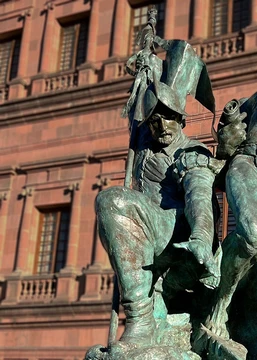
Vitus Bering
Danish-born Russian explorer of Asia and North America.

Wikipedia / Wikimedia Commons
Vitus Jonassen Bering (baptised 5 August 1681 – 19 December 1741), also called Ivan Ivanovich Bering, was a cartographer, explorer, and officer in the Russian Navy who was born in Denmark. He led two major Russian expeditions: the First Kamchatka Expedition and the Great Northern Expedition. These voyages charted the northeastern coast of Asia and, from there, the western coast of North America. Several geographic features bear his name, including the Bering Strait, the Bering Sea, Bering Island, the Bering Glacier, and Vitus Lake.
Bering was born in the Danish port town of Horsens to Anne Pedderdatter and Jonas Svendsen, a customs inspector and churchwarden. He was baptised in the local Lutheran church on 5 August 1681. His name came from a maternal great-uncle, Vitus Pedersen Bering, a recently deceased royal court chronicler. The family was reasonably well-off; two of Bering’s elder half-brothers attended the University of Copenhagen.
At age 15, Bering became a ship’s boy. From 1696 to 1704, he sailed to India and the Dutch East Indies, and also completed naval officer training in Amsterdam. He later claimed, with some supporting evidence, to have served on Danish whalers in the North Atlantic and to have visited European colonies in the Caribbean and along North America’s eastern seaboard.
In 1704, Bering joined the rapidly expanding navy of Tsar Peter I. Under the guidance of Norwegian-born Russian admiral Cornelius Cruys, he received a commission as a sub-lieutenant. He rose steadily through the ranks, becoming a second captain by 1720. Although he saw no sea battles, he commanded vessels on dangerous missions, such as transporting a ship from the Azov Sea to the Baltic. During the later stages of the Great Northern War (which ended in 1721), his work mainly involved lightering duties.
On 8 October 1713, Bering married Anna Christina Pülse at the Lutheran church in Vyborg. Anna, the daughter of a Swedish merchant, was about 11 years younger than Bering. Over the next 18 years, they had nine children, only four of whom survived childhood. Because of his naval service, especially during the Great Northern War, Bering spent little time with his family.
After the Great Northern War ended in 1721, Bering was not promoted, unlike many of his peers. This became especially embarrassing in 1724, when Anna’s younger sister Eufemia married Thomas Saunders. T
- born
- baptised 5 August 1681, Horsens, Denmark
- died
- 19 December 1741
- field
- Cartography, exploration, naval service
- nationality
- Danish-born Russian
- known_for
- First Kamchatka Expedition, Great Northern Expedition, exploration of northeastern Asia and western North America
Lore & Background
Vitus Bering was born in the port town of Horsens in Denmark to Anne Pedderdatter and Jonas Svendsen, a customs inspector and churchwarden. He was baptized in the Lutheran church on 5 August 1681. Named after a maternal great-uncle, Vitus Pedersen Bering, a royal court chronicler, Bering signed on as a ship's boy at age 15. Between 1696 and 1704, he traveled the seas, reaching India and the Dutch East Indies, and completed naval officer training in Amsterdam. He later claimed to have served on Danish whalers in the North Atlantic, visiting European colonies in the Caribbean and on North America's eastern seaboard.
In 1704, Bering enrolled in the navy of Tsar Peter I and gained an officer's commission under Norwegian-born Russian admiral Cornelius Cruys, reaching the rank of second captain by 1720. He married Anna Christina Pülse on 8 October 1713 in Vyborg; they had nine children, four of whom survived childhood. After the Great Northern War ended in 1721, Bering was not promoted like many contemporaries, and retired to avoid embarrassment, securing the rank of first captain. He rejoined the Russian Navy later that year and by 2 October 1724 was commanding the 90-gun Lesnoe.
On 29 December 1724, Peter I ordered Bering to captain the First Kamchatka Expedition, tasked with sailing north from Kamchatka to determine whether Asia and America shared a land border. Bering's lieutenants were Martin Spanberg and Aleksei Chirikov. The expedition traveled overland from St. Petersburg to Okhotsk, then by sea to Kamchatka, encountering many difficulties. Bering repeated a little-documented journey of Semyon Dezhnyov 80 years earlier.
Reader's Guide
Vitus Bering's significance lies in his leadership of two major Russian expeditions that mapped the northeastern coast of Asia and the western coast of North America. The First Kamchatka Expedition, ordered by Peter I, sought to determine whether Asia and America were connected by land. Bering's voyages provided crucial geographic knowledge, leading to the naming of the Bering Strait, Bering Sea, Bering Island, Bering Glacier, and Vitus Lake in his honor. His work expanded Russian imperial reach and contributed to European understanding of the Pacific region. Despite personal challenges, including a stalled career and family obligations, Bering's perseverance in exploring harsh, uncharted territories established him as a key figure in the history of exploration. His legacy endures through the geographic features that bear his name, symbolizing the connection between two continents.
Did You Know?
- Bering was also known as Ivan Ivanovich Bering.
- He was named after a maternal great-uncle, Vitus Pedersen Bering, a royal court chronicler.
- Bering married Anna Christina Pülse on 8 October 1713 in the Lutheran church at Vyborg.
- The Bering Strait, Bering Sea, Bering Island, Bering Glacier, and Vitus Lake were all named in his honor.
More in Explorers & Conquistadors 1-20
Spotted an error? Know more?
This is a living reference — every entry is fact-audited, and reader corrections feed straight into our audit queue. Suggest an edit · See this site's audit record