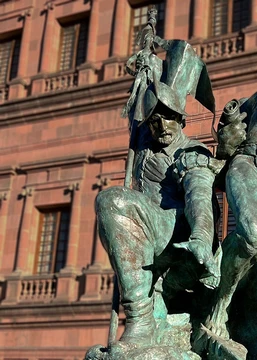
Wang Dayuan
14th-century Chinese traveller who documented early Singapore and Taiwan.

Wikipedia / Wikimedia Commons
Wang Dayuan (c. 1311–1350), also known by his courtesy name Huanzhang, was a 14th-century traveler from Jiangxi, China. He undertook two major sea voyages. Between 1328 and 1333, he sailed through the South China Sea, visiting many parts of Southeast Asia and reaching as far as South Asia—including what are now Bangladesh, Sri Lanka, and India. From 1334 to 1339, his travels extended to North and East Africa.
Around 1330, Wang visited the island of Singapore. There he recorded a small settlement called Danmaxi (Temasek), which had both Malay and Chinese residents and already featured an established Chinatown. His 1349 travelogue, *Dao Yi Zhi Lue* (A Brief Account of Island Barbarians), is one of the few surviving records of early Singapore.
In that same work, Wang provided the first written account of a visit to Taiwan. He described it as the first overseas kingdom, writing that “overseas countries start from here.” He found no Chinese settlers on Taiwan itself, though many lived on the Penghu Islands. Wang referred to different parts of Taiwan as Liuqiu and Pisheye. Liuqiu, he wrote, was a large land with towering trees and mountains named Cuilu, Zhongman, Futou, and Dazhi. One of these mountains was visible from Penghu; Wang climbed it and could see the coasts. The land had fertile fields and was hotter than Penghu. Its people had different customs: they used only rafts, not boats, and both men and women bound their hair and wore colored garments. They made salt by boiling seawater and liquor from fermented sugarcane juice. Local chiefs were respected, and father-son relationships were described as bone-and-flesh. The people practiced cannibalism against enemies. Products included gold, beans, millet, sulfur, beeswax, deer hide, leopards, and moose. Trade goods accepted were pearls, agates, gold, beads, dishware, and pottery.
Pisheye, according to Wang, lay to the east. It had extensive mountains and plains, but the people did little farming and produced few goods. The climate was even hotter than Liuqiu. Its inhabitants wore their hair in tufts, tattooed their bodies with black juice, and wrapped red silk and yellow cloth around their heads. Pisheye had no chief; the people hid in wild mountains and valleys, raiding and plundering by boat. Kidnapping and slave trading were common. Historian Efren B. Isorena, analyzing historical accounts and wind curre
- born
- c. 1311, Hongzhou (present-day Nanchang)
- died
- Unknown
- field
- Travel, geography
- nationality
- Chinese
- known_for
- Two major ship voyages; author of Dao Yi Zhi Lue (A Brief Account of Island Barbarians)
Lore & Background
In 1349, Wang Dayuan provided the first written account of a visit to Taiwan. He described it as the first overseas kingdom or country, stating 'Overseas countries start from here.' He found no Chinese settlers there but many on Penghu. Wang called different regions of Taiwan Liuqiu and Pisheye. According to Wang, Liuqiu was a vast land of huge trees and mountains; its people did not have boats and oars but only rafts, obtained salt from boiled sea water and liquor from fermented sugarcane juice, and practiced cannibalism against their enemies. Pisheye, located to the east, had people who wore their hair in tufts, tattooed their bodies, and practiced raiding and plundering by boat.
Reader's Guide
Wang Dayuan's significance lies in his eyewitness accounts of regions rarely documented by Chinese travellers in the 14th century. His work, Dao Yi Zhi Lue, is one of the few records documenting the early history of Singapore, describing a multicultural settlement with an established Chinatown before European colonization. His descriptions of Taiwan provide the earliest written account of the island, noting the absence of Chinese settlers and detailing the customs of indigenous groups such as those in Liuqiu and Pisheye. The historian Efren B. Isorena later used Wang's account of Pisheye, along with analysis of wind currents, to suggest a close relationship between the Pisheye of Taiwan and the Bisaya of the Visayas islands in the Philippines. Wang's travels also extended to South Asia and Africa, making his writings a valuable source for understanding pre-modern trade routes and cultural contacts across the Indian Ocean and beyond.
Did You Know?
- Wang Dayuan visited Singapore around 1330 and described a settlement called Danmaxi (Temasek) with both Malay and Chinese residents and an established Chinatown.
- He provided the first written account of a visit to Taiwan in 1349, noting no Chinese settlers there but many on Penghu.
- Wang described the people of Liuqiu (Taiwan) as using only rafts, obtaining salt from boiled sea water, and practicing cannibalism against their enemies.
- The historian Efren B. Isorena concluded that the Pisheye of Taiwan and the Bisaya of the Visayas islands were closely related people based on Wang's account and wind current analysis.
More in Explorers & Conquistadors 1-20
Spotted an error? Know more?
This is a living reference — every entry is fact-audited, and reader corrections feed straight into our audit queue. Suggest an edit · See this site's audit record