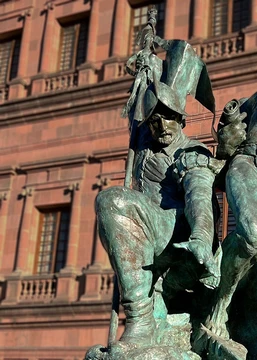
Vasco Núñez de Balboa
Spanish explorer who first sighted the Pacific Ocean from Panama.

Wikipedia / Wikimedia Commons
Vasco Núñez de Balboa (c. 1475 – around January 12–21, 1519) was a Spanish explorer, governor, conquistador, and adelantado. He is most famous for becoming the first European to spot the Pacific Ocean, which he did while crossing the Isthmus of Panama in 1513. He also established Santa María la Antigua del Darién in what is now Panama in 1510, marking the first permanent European settlement on the American mainland.
Born in Jerez de los Caballeros, Spain, Balboa was one of several children, though the exact number and birth order are not confirmed by historical records. His father was the nobleman Nuño Arias de Balboa, and his mother was María de Badajoz. As a youth, he served as a page and squire to Don Pedro de Portocarrero, lord of Moguer.
In 1501, spurred by news of Columbus’s voyages, Balboa joined Rodrigo de Bastidas’s expedition alongside Juan de la Cosa. Under the quinto real policy, the Crown took one-fifth of any treasure, while the remaining four-fifths were subject to other shares and costs. The expedition sailed along the Caribbean coast from eastern Panama, past the Colombian shore and the Gulf of Urabá, to Cabo de la Vela. After exploring northeastern South America, the expedition ended because their ships were damaged and leaking, forcing them to head to Hispaniola.
Balboa settled in Hispaniola in 1505, working as a planter and pig farmer, but he failed at this and fell into debt, forcing him to leave the island. In 1508, King Ferdinand II of Spain ordered the conquest of Tierra Firme, roughly the Isthmus of Panama. He split the region between Cabo de la Vela and Cabo de Gracias a Dios into two territories: Nueva Andalucía (east, under Alonso de Ojeda) and Veragua (west, under Diego de Nicuesa), with the Gulf of Urabá as the border.
In 1509, hoping to flee his creditors in Santo Domingo, Balboa joined an expedition led by Martín Fernández de Enciso, the Alcalde Mayor of Nueva Andalucía, who was sent to aid Ojeda. Ojeda had founded San Sebastián de Urabá with 70 men, but local natives using poisoned weapons wounded him. Ojeda sailed for Hispaniola, leaving Francisco Pizarro in charge, with orders to wait 50 days for help; if none came, the men were to return to Hispaniola.
When Enciso discovered Balboa, he threatened to abandon him on an uninhabited island, but relented after realizing Balboa knew the region from his earlier exploration
- born
- c. 1475, Jerez de los Caballeros, Spain
- died
- around January 12–21, 1519
- field
- Exploration, conquest, governance
- nationality
- Spanish
- known_for
- First European to discover the Pacific Ocean (1513); founder of first permanent mainland European settlement in the Americas; governor of Darién
Lore & Background
Balboa was born in Jerez de los Caballeros, Spain, one of several children, though the exact number and birth order are not confirmed by historical records. He served as a page and squire to Don Pedro de Portocarrero. In 1501, he joined Rodrigo de Bastidas' expedition to the New World, exploring the Caribbean coasts from eastern Panama to Cabo de la Vela. The expedition ended when their ships became damaged and leaking. After settling in Hispaniola in 1505 as a planter and pig farmer, he fell into debt and was forced to leave. In 1509, to escape creditors, he joined an expedition led by Martín Fernández de Enciso. Discovered, he was spared due to his knowledge of the region and the crew's pleas.
After the destruction of San Sebastián de Urabá, Balboa helped establish Santa María la Antigua del Darién in modern-day Panama. He later became governor of Darién, not Veragua, which was a separate jurisdiction. Though some legends claim he was a descendant of the Lord mason of the castle of Balboa, this is not supported by reliable historical records.
Reader's Guide
Balboa's significance lies in his dual role as a pioneer of European settlement and as the first European to reach the Pacific Ocean from the New World. His founding of Santa María la Antigua del Darién established a permanent European foothold on the American mainland, a critical step in Spanish colonization. His discovery of the Pacific in 1513 opened the way for further exploration and eventual Spanish dominance in the region. However, his career also illustrates the violent and often lawless nature of early conquest, including his turn to piracy and his ouster of rival governors. His legacy is thus one of both achievement and the brutal realities of empire-building.
Did You Know?
- Balboa stowed away on an expedition by hiding inside a barrel with his dog Leoncico.
- He founded Santa María la Antigua del Darién in 1510, the first permanent European settlement on the mainland of the Americas.
- After ousting Governor Diego de Nicuesa, Balboa became governor of Veragua.
- He was a descendant of the Lord mason of the castle of Balboa, on the borders of León and Galicia.
More in Explorers & Conquistadors 1-20
Spotted an error? Know more?
This is a living reference — every entry is fact-audited, and reader corrections feed straight into our audit queue. Suggest an edit · See this site's audit record