Vicente Yáñez Pinzón
Spanish navigator, captain of the Niña, and Amazon River discoverer.

Wikipedia / Wikimedia Commons
Vicente Yáñez Pinzón (c. 1462 – after 1514) was a Spanish navigator and explorer, the youngest of the Pinzón brothers. He captained the Niña on the 1492 voyage that reached the New World, while his older brother Martín Alonso Pinzón commanded the Pinta and Christopher Columbus captained the Santa María.
Born in Palos de la Frontera on the Atlantic coast of Huelva, he was the youngest of three prominent sons of seaman Martín Pinzón and his wife Mayor Vicente. His birth year is uncertain, generally given as around 1462; historian Juan Gil argues from legal documents that his two daughters were over twenty in 1509, meaning he could not have been born later than 1469. Records show he served as a corsair or privateer with his brother Martín Alonso in Mediterranean waters between 1477 and 1479, when other towns failed to supply Palos with grain during wartime.
He married twice: first to Teresa Rodríguez, with whom he had two daughters, Ana Rodríguez Pinzón and Juana González Pinzón; and second, probably in 1509, to Ana de Trujillo, sometimes called Ana Núñez de Trujillo in surviving documents. He lived in Palos through Columbus’s first voyage, moved to Moguer by 1495, and relocated to Seville no later than 1502—possibly to escape creditors after the financial failure of his 1499–1500 expedition. Gil found evidence that his first wife owned a mansion in Triana, across the river from Seville, which passed to their daughters. The last primary record of him dates to 1514, in Seville or Triana. Chronicler Gonzalo Fernández de Oviedo y Valdés reported that he died that year, likely in late September, and was probably buried in the cemetery of Triana.
In 1499, Pinzón sailed to the South American coast, disembarking at what is now Praia do Paraíso in Cabo de Santo Agostinho, Pernambuco, or further northwest near present-day Fortaleza, Ceará. Though the Treaty of Tordesillas barred Castile from claiming the land, he named it Cabo de Santa María de la Consolación. He sighted the Amazon River and noted its vast freshwater current, calling it Río Santa María de la Mar Dulce, becoming the first European to observe an Amazon estuary. He is sometimes credited with discovering the Oiapoque River, though this is disputed. Unlike other family members, he remained loyal to Columbus, resisting official efforts during the pleitos to elicit anti-Columbus statements.
I
- known_for
- Captain of the Niña on Columbus's first voyage; first European to sight the Amazon River estuary
Lore & Background
Pinzón was born in Palos de la Frontera, the youngest of three sons of seaman Martín Pinzón and Mayor Vicente. His birth year is uncertain, generally given as c. 1462, though legal documents suggest it cannot be later than 1469. He served as a corsair or privateer with his older brother Martín Alonso in Mediterranean waters between 1477 and 1479. He married twice: first to Teresa Rodríguez, with whom he had two daughters, and second, probably in 1509, to Ana de Trujillo.
Pinzón was based in Palos at least through Columbus's first voyage in 1492; by 1495 he lived in Moguer, and after the economic failure of his 1499–1500 expedition, he moved to Seville no later than 1502, possibly to escape creditors. The last primary record of him is in 1514, in Seville or Triana. According to chronicler Gonzalo Fernández de Oviedo y Valdés, he died that year, probably at the end of September, and was buried in the cemetery of Triana.
In 1499, Pinzón sailed to the South American coast, disembarking at a shore he named 'Cabo de Santa María de la Consolación' (present-day Brazil). He sighted the Amazon River and ascended about fifty miles from the sea, calling it 'Río Santa María de la Mar Dulce.' He also discovered the Oiapoque River. Unlike other Pinzón family members, he remained loyal to Columbus and resisted efforts to give anti-Columbus statements during the pleitos.
Reader's Guide
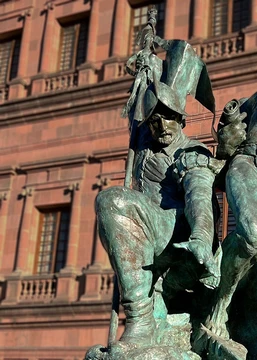
Vicente Yáñez Pinzón is significant primarily for his role in the first voyage of Christopher Columbus, commanding the Niña, and for his own exploratory voyage in 1499–1500, during which he became the first European to discover the Amazon River estuary. His discovery of the Amazon, which he named 'Río Santa María de la Mar Dulce,' predated other European explorations of the region. Although the Treaty of Tordesillas prevented Castile from claiming the land, his voyage contributed to European knowledge of the South American coastline. Pinzón also discovered the Oiapoque River. His loyalty to Columbus, in contrast to other family members, is noted in historical records. His legacy is commemorated in the genus Pinzona of flowering plants, named in his honor in 1832, and in Pinzón Island in the Galapagos, named for him and his brother. A statue of the brothers was dedicated in Palos de la Frontera in 1999 on the fifth centennial of the discovery of Brazil.
Did You Know?
- Pinzón was the youngest of the Pinzón brothers and captained the Niña on Columbus's first voyage.
- He was the first European to discover an estuary of the Amazon River, which he called 'Río Santa María de la Mar Dulce.'
- He served as a corsair or privateer with his older brother in Mediterranean waters between 1477 and 1479.
- A genus of flowering plants, Pinzona, was named in his honor in 1832.
More in Explorers & Conquistadors 1-20
Spotted an error? Know more?
This is a living reference — every entry is fact-audited, and reader corrections feed straight into our audit queue. Suggest an edit · See this site's audit record