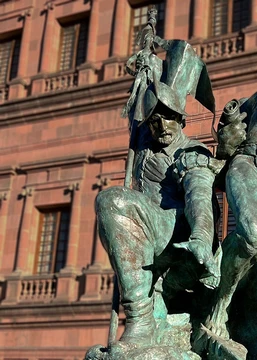
Willem Barentsz
Dutch navigator who sought the Northeast passage and explored the Arctic.

Wikipedia / Wikimedia Commons
Willem Barentsz (c. 1550 – 20 June 1597) was a Dutch navigator, cartographer, and Arctic explorer. He is best known for his three expeditions in search of a Northeast passage to China, during which he discovered Spitsbergen and Bear Island, and for the wintering of his crew on Novaya Zemlya after their ship became trapped in ice. The Barents Sea is named after him.
- born
- c. 1550, Formerum, Terschelling, Seventeen Provinces (present-day Netherlands)
- died
- 20 June 1597, on or near Novaya Zemlya
- field
- Navigation, cartography, Arctic exploration
- nationality
- Dutch
- known_for
- Three Arctic expeditions seeking a Northeast passage; discovery of Spitsbergen and Bear Island; wintering on Novaya Zemlya
Lore & Background
Willem Barentsz was born around 1550 in the village Formerum on the island Terschelling. His name Barentsz is a patronymic, short for Barentszoon, meaning 'Barent's son'. A cartographer by trade, he sailed to Spain and the Mediterranean to complete an atlas of that region, co-published with Petrus Plancius. He reasoned that clear, open water north of Siberia must exist because the sun shone 24 hours a day melting Arctic sea ice, believing the farther north one went the less ice there would be.
On his first voyage (1594), Barentsz left Texel aboard the small ship Mercury as part of a three-ship expedition. He reached the west coast of Novaya Zemlya but was forced back by large icebergs. The trip was considered a success. The second voyage (1595), with six ships and Prince Maurice of Orange's backing, went between the Siberian coast and Vaygach Island but turned back when the Kara Sea was found frozen, a failure.
His third expedition (1596) set out with two ships captained by Jan Rijp and Jacob van Heemskerk. They discovered Bear Island on 9 June and Spitsbergen on 17 June. After a disagreement, Barentsz continued northeast, reaching Novaya Zemlya on 17 July. The ship became stuck in ice, and the 16-man crew wintered in a lodge built from driftwood and ship lumber, called Het Behouden Huys. Barentsz died on the return voyage on 20 June 1597.
Reader's Guide
Willem Barentsz's significance lies in his pioneering Arctic exploration and his contributions to cartography. His three expeditions, though failing to find a Northeast passage, greatly expanded European knowledge of the high Arctic. The discovery of Spitsbergen and Bear Island opened new regions for exploration and later whaling. The wintering on Novaya Zemlya, documented by crew member Gerrit de Veer, provided one of the earliest detailed accounts of surviving an Arctic winter, including the first recorded observation of the polar mirage now called the Novaya Zemlya effect. The Barents Sea, named after him, remains a key geographical feature. His legacy endures in the place names and in the story of endurance against extreme cold and ice.
Did You Know?
- Barentsz's name is a patronymic, short for Barentszoon, meaning 'Barent's son'.
- During his first voyage, the crew encountered a polar bear that they tried to capture but had to kill after it rampaged aboard the ship.
- On the third expedition, the crew became the first to witness and record the atmospheric anomaly now called the Novaya Zemlya effect.
- Nearly three centuries later, in 1871, the Norwegian seal hunter Elling Carlsen found the winter lodge still standing and largely undisturbed.
More in Explorers & Conquistadors 1-20
Spotted an error? Know more?
This is a living reference — every entry is fact-audited, and reader corrections feed straight into our audit queue. Suggest an edit · See this site's audit record