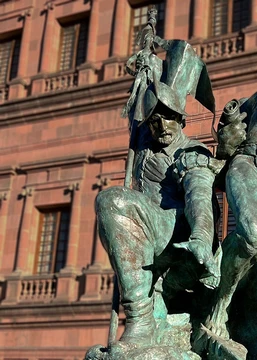
William of Rubruck
Franciscan friar who traveled to the Mongol Empire and wrote a travel account.
William of Rubruck was a Franciscan friar from the County of Flanders in the Kingdom of France. He is known for undertaking a mission to the Great Khan Möngke of the Mongol Empire with the support of King Louis IX of France, and for writing the Itinerarium, a detailed account of his travels that became a masterwork of medieval travel literature.
- born
- likely 1210s or 1220s, Rubrouck, County of Flanders, Kingdom of France
- died
- according to sources, 1270s or after 1293
- field
- Travel, missionary work, geography
- nationality
- Flemish (Kingdom of France)
- known_for
- Travels to the Mongol Empire (1253–1254); author of the Itinerarium
Lore & Background
William of Rubruck was born likely in the 1210s or 1220s in Rubrouck, County of Flanders, Kingdom of France. In 1248, he accompanied King Louis IX of France on the Seventh Crusade. On 7 May 1253, on Louis' orders, he set out on a missionary journey to convert the Tatars to Christianity. He first stopped in Constantinople to confer with Baldwin of Hainaut, who had recently returned from a trip to Karakorum, the capital of the Mongol Empire. There, William received letters to some of the Tatar chiefs from the emperor. With William's party were Bartolomeo da Cremona, an attendant called Gosset, and an interpreter named Homo Dei.
Reader's Guide
William of Rubruck's significance lies in his detailed and reliable account of the Mongol Empire, which he visited in 1253–1254, preceding the journeys of Marco Polo and Odoric of Pordenone. His Itinerarium, addressed to King Louis IX, provides extensive descriptions of Karakorum's walls, markets, temples, and the cosmopolitan population, including separate quarters for Muslim and Chinese craftsmen. He also demonstrated that the Caspian Sea was an inland sea, not flowing into the Arctic Ocean, answering a long-standing geographical question. His work is considered one of the great masterpieces of medieval geographical literature, comparable to those of Marco Polo and Ibn Battuta, though it never attained the popularity of Marco Polo's book. Roger Bacon cited William copiously in his Opus Majus, but after Bacon the narrative dropped out of sight until Richard Hakluyt's 1599 publication. William's account remains an essential historical source for understanding the Mongol Empire and medieval travel.
Did You Know?
- William of Rubruck traveled to Mongolia in 1253–1254, preceding the journeys of Marco Polo and Odoric of Pordenone.
- He visited Karakorum, the capital of the Mongol Empire, and provided descriptions of its walls, markets, and temples.
- William demonstrated that the Caspian Sea was an inland sea and did not flow into the Arctic Ocean.
- He participated in a theological debate at the Mongol court in May 1254, with Christians, Buddhists, and Muslims.
More in Explorers & Conquistadors 1-20
Spotted an error? Know more?
This is a living reference — every entry is fact-audited, and reader corrections feed straight into our audit queue. Suggest an edit · See this site's audit record