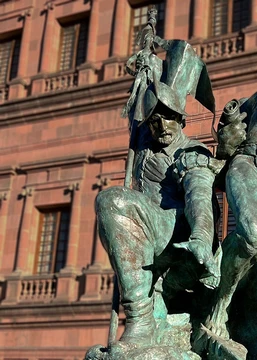
Walter Raleigh
English statesman, soldier, writer and explorer of the Elizabethan era.

Wikipedia / Wikimedia Commons
Sir Walter Raleigh, who lived from around 1553 until his execution on 29 October 1618, was an English statesman, soldier, writer, and explorer. A key figure in the Elizabethan era, he was instrumental in England’s efforts to colonise North America, helped put down rebellion in Ireland, took part in defending England against the Spanish Armada, and served in political roles under Queen Elizabeth I.
Born into a Protestant landed gentry family in Devon, he was the son of Walter Raleigh and Catherine Champernowne, who was herself the daughter of Sir Philip Champernowne. Raleigh was the younger half-brother of Sir Humphrey Gilbert and a cousin of Sir Richard Grenville. Not much is known about his early years, but as a teenager he spent time in France fighting in the religious civil wars. In his twenties, he helped suppress a rebellion during the colonisation of Ireland and was present at the siege of Smerwick. Later, he owned property in Ireland and served as mayor of Youghal in east Munster.
Raleigh quickly gained favour with Queen Elizabeth I and was knighted in 1584. He received a royal patent in 1584 to explore and colonise lands in North America, which later came to be called Virginia, helping pave the way for later English settlements. In 1591, he secretly married Elizabeth Throckmorton, one of the queen’s ladies-in-waiting, without Elizabeth’s permission. As punishment, both he and his wife were sent to the Tower of London. After being released, they retired to his estate at Sherborne, Dorset.
In 1594, Raleigh heard rumours of a “City of Gold” in South America and set sail to find it. He later published an exaggerated account of his journey, which helped fuel the legend of El Dorado. After Queen Elizabeth died in 1603, Raleigh was again imprisoned in the Tower, this time for his involvement in the Main Plot against King James I, who did not look favourably on him. In 1616, he was freed to lead a second expedition searching for El Dorado. During that trip, men under his top commander attacked a Spanish outpost, breaking both the terms of his pardon and the 1604 peace treaty with Spain. When Raleigh returned to England, he was arrested and executed in 1618 to appease the Spanish.
Little is known about Raleigh’s exact birth date, but he is thought to have been born on 22 January 1552 or possibly 1554. He grew up at Hayes Barton in East Devon, the youngest
- born
- c. 1553 (possibly 22 January 1552 or 1554)
- died
- 29 October 1618
- field
- Statesman, soldier, writer, explorer
- nationality
- English
- known_for
- English colonisation of North America, search for El Dorado, involvement in the Roanoke Colony
Lore & Background
Raleigh was born to a landed gentry family of Protestant faith in Devon, the son of Walter Raleigh and Catherine Champernowne. He was the younger half-brother of Sir Humphrey Gilbert and a cousin of Sir Richard Grenville. Little is known of his early life, though in his late teens he spent some time in France taking part in the religious civil wars. In his 20s he took part in the suppression of rebellion in the colonisation of Ireland; he also participated in the siege of Smerwick. Later, he became a landlord of property in Ireland and mayor of Youghal in east Munster.
Raleigh rose rapidly in the favour of Queen Elizabeth I and was knighted in 1584. He was granted a royal patent in 1584 to explore and colonise lands in North America, which later became known as Virginia, paving
Reader's Guide
Raleigh's significance lies in his role as a leading figure in English exploration and colonisation during the Elizabethan era. His royal charter to explore Virginia led to the Roanoke Colony, the first English settlement in North America, though it ultimately failed. His expeditions in search of El Dorado, while unsuccessful, fueled enduring legends and European interest in South America. Raleigh's life also illustrates the volatile nature of court favour: he rose under Elizabeth I, was imprisoned for marrying without permission, and later executed under James I after a failed expedition that violated a peace treaty with Spain. His writings, including an account of his South American voyage, contributed to the literature of exploration. Despite his execution, Raleigh's efforts helped establish a precedent for English overseas expansion.
Did You Know?
- Raleigh was the younger half-brother of Sir Humphrey Gilbert and a cousin of Sir Richard Grenville.
- He was imprisoned in the Tower of London twice: once for marrying Elizabeth Throckmorton without the Queen's permission, and later for involvement in the Main Plot against King James I.
- Raleigh published an exaggerated account of his search for El Dorado that contributed to the legend.
- He is credited with introducing potatoes to England and Ireland, though the article notes this is disputed.
More in Explorers & Conquistadors 1-20
Spotted an error? Know more?
This is a living reference — every entry is fact-audited, and reader corrections feed straight into our audit queue. Suggest an edit · See this site's audit record