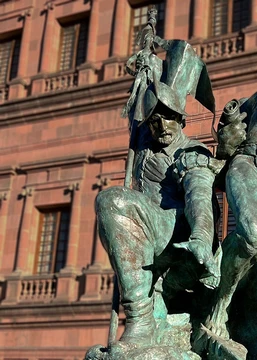
William Clark
Explorer, soldier, and diplomat who mapped the American West.

Wikipedia / Wikimedia Commons
William Clark (August 1, 1770 – September 1, 1838) was an American explorer, soldier, Indian agent, and territorial governor. He is best remembered for sharing command of the Lewis and Clark Expedition from 1804 to 1806, the first major undertaking to chart much of the present-day Western United States and strengthen American claims to the Pacific Northwest.
Clark was born in Caroline County, Virginia, the ninth of ten children. His parents, John and Ann Rogers Clark, were English and possibly Scots, owned several modest plantations and enslaved people, and belonged to the Anglican Church. He received no formal schooling, learning instead from tutors at home. Later in life, he felt self-conscious about his irregular grammar and spelling—he wrote "Sioux" 27 different ways in his expedition journals—and wanted them corrected before publication. Though spelling was not yet standardized, his vocabulary showed he was well read. Five older brothers fought in the American Revolution, but William was too young. His eldest brother, Jonathan, became a colonel and later a brigadier general in the Virginia militia; another brother, George Rogers Clark, rose to general and fought in Kentucky against British-allied Native Americans. After the war, the two oldest brothers arranged for the family to move to Kentucky. William, his parents, three sisters, and the family’s enslaved people arrived in March 1785, traveling overland to Redstone Landing (now Brownsville, Pennsylvania) and then down the Ohio River by flatboat. They settled at "Mulberry Hill," a plantation on Beargrass Creek near Louisville, which was Clark’s main home until 1803. There, George Rogers Clark taught him wilderness survival.
During the Northwest Indian War, 19-year-old Clark joined a volunteer militia under Major John Hardin in 1789, keeping a detailed journal of the campaign—a habit he kept for life. Hardin’s force advanced against the Wea Indians on the Wabash River but mistakenly attacked a peaceful Shawnee hunting camp, killing eight men, women, and children. In 1790, General Arthur St. Clair commissioned Clark as a captain in the Clarksville, Indiana militia. One older source says he was sent on a mission to the Creek and Cherokee in the Southeast, possibly visiting New Orleans, which kept him from participating in General Josiah Harmar’s failed campaign. In 1791, he served as an ensign and acti
- born
- August 1, 1770, Caroline County, Virginia
- died
- September 1, 1838
- field
- Exploration, military, Indian affairs, territorial governance
- nationality
- American
- known_for
- Co-leading the Lewis and Clark Expedition
Lore & Background
William Clark was born in Virginia, the ninth of ten children. He had no formal education but was tutored at home; his journals show inconsistent spelling and grammar, reflecting the unstandardized English of his time. His family relocated to Kentucky in 1785, where his older brother George Rogers Clark taught him wilderness survival skills. Clark began his military career in 1789, joining a volunteer militia, and later served in the Legion of the United States, fighting in the Northwest Indian War, including the Battle of Fallen Timbers in 1794. He resigned his commission in 1796 due to poor health and returned to his family's plantation.
Reader's Guide
William Clark's significance lies primarily in his role as co-commander of the Lewis and Clark Expedition, which mapped the Louisiana Purchase and strengthened U.S. claims to the Pacific Northwest. After the expedition, he served as a brigadier general of the Louisiana Territory militia, U.S. agent for Indian affairs, and governor of the Missouri Territory. From 1822 until his death in 1838, he was Superintendent of Indian Affairs in St. Louis. His diplomacy with Native Americans was marked by a commitment to U.S. expansion, though he showed genuine concern for native peoples, earning him the label 'Indian lover' from frontier settlers. His legacy includes his detailed journals and maps, which remain primary sources for the expedition.
Did You Know?
- Clark spelled 'Sioux' 27 different ways in his expedition journals.
- He took his personal slave York on the expedition, and Native Americans treated York with respect.
- Clark served as U.S. Superintendent of Indian Affairs in St. Louis from 1822 until his death in 1838.
- He was a member of the Freemasons; a traveling certificate was issued for him in 1809.
More in Explorers & Conquistadors 1-20
Spotted an error? Know more?
This is a living reference — every entry is fact-audited, and reader corrections feed straight into our audit queue. Suggest an edit · See this site's audit record