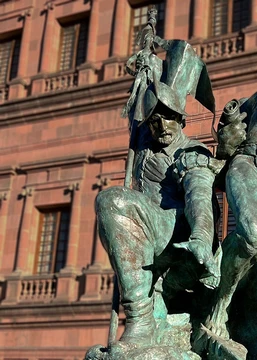
Xu Fu
Chinese alchemist who vanished seeking the elixir of life.
Xu Fu (also known as Hsu Fu, Jofuku, or Seo Bok) was a Chinese alchemist and explorer born in 255 BC in the ancient Chinese state of Qi. He served as a court sorcerer under Qin Shi Huang, the first emperor of the Qin dynasty, and is best known for being sent on two maritime expeditions to find the elixir of life, from which he never returned.
- born
- 255 BC, Qi (ancient Chinese state)
- died
- Disappeared at sea in 210 BC
- field
- Alchemy, exploration
- nationality
- Chinese (Qin dynasty)
- known_for
- Voyages to find the elixir of life; legendary settlement in Japan
Lore & Background
Xu Fu was a court sorcerer for Qin Shi Huang, who feared death and sought immortality. In 219 BC, the emperor sent Xu Fu with 3,000 virgin boys and 3,000 virgin girls, along with soldiers, crew, and craftsmen, to find the elixir of life from immortals on Mount Penglai. Xu sailed for several years without success. In 210 BC, when questioned, he claimed a giant sea creature blocked his path; the emperor provided archers to kill a giant fish, after which Xu set sail again and never returned.
The Records of the Grand Historian states that Xu Fu reached a place with 'flat plains and wide swamps' and proclaimed himself king. Later texts, including the Records of the Three Kingdoms and Book of the Later Han, say he landed in 'Danzhou,' but its location is unknown. Over 1,100 years later, monk Yichu wrote that Xu Fu landed in Japan and named Mount Fuji as Penglai, forming the basis of the Japanese 'Legend of Xu Fu.'
Reader's Guide
Xu Fu's significance lies in his role as a legendary figure bridging Chinese and Japanese history. According to later texts, he is said to have introduced farming techniques, medicine, and silk cultivation to ancient Japan, leading to his worship there as the 'god of farming,' 'god of medicine,' and 'god of silk.' Numerous temples and memorials in Japan honor him, including Jofuku Park in Shingu, Wakayama Prefecture. The Japanese historian Ino Okifu even identified Emperor Jimmu with Xu Fu. However, the historicity of his settlement in Japan is debated: some scholars consider it possible, while others cite inconsistencies and lack of compelling evidence. Genetic research shows the Japanese people are an admixture of indigenous Jōmon and later Yayoi migrants, with the Yayoi period starting around the time of his supposed arrival. The legend continues to inspire academic symposia, such as the 2008 Saga Xu Fu International Symposium.
Did You Know?
- Xu Fu's fleet reportedly included 60 barques with soldiers, crew, 3,000 boys, and 3,000 girls.
- The Records of the Grand Historian says Xu Fu reached a place with 'flat plains and wide swamps' and proclaimed himself king.
- Monk Yichu, writing over 1,100 years after Xu Fu's voyage, claimed Xu Fu landed in Japan and named Mount Fuji as Penglai.
- In Saga City, Japan, a place called 'Bubai' (meaning 'floating cup') marks where Xu Fu is said to have landed.
More in Explorers & Conquistadors 1-20
Spotted an error? Know more?
This is a living reference — every entry is fact-audited, and reader corrections feed straight into our audit queue. Suggest an edit · See this site's audit record