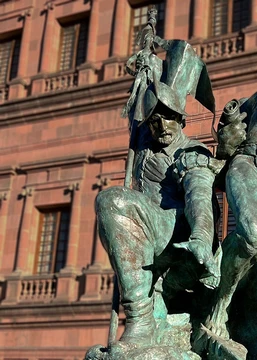
Zebulon Pike
American brigadier general and explorer of the Louisiana Purchase.
Zebulon Montgomery Pike was born on January 5, 1779, in Lamington, New Jersey, to Isabella Brown and Zebulon Pike. His father began his own military career in 1775 at the start of the American Revolution, and through him, Zebulon Jr. was a direct descendant of Robert Pike, a noted opponent of the Salem witch trials of 1692. Pike grew up at various frontier outposts in Ohio and Illinois, then the northwestern edge of the United States. He was commissioned a second lieutenant of infantry in 1799 and promoted to first lieutenant later that same year.
In 1801, Pike married his cousin Clarissa Harlow Brown. Only one of their five children, a daughter named Clarissa Brown Pike, survived to adulthood; she later married John Cleves Symmes Harrison, son of President William Henry Harrison. Pike was also the great-granduncle of Medal of Honor recipient Emory Jenison Pike.
Pike’s military career involved logistics and payroll work at frontier posts, including Fort Belle Fontaine near present-day St. Louis. There, General-in-Chief James Wilkinson—appointed by President Thomas Jefferson as the first governor of Upper Louisiana Territory—became Pike’s mentor. In 1796, Pike shadowed an expedition led by French officer Georges Henri Victor Collot, who was mapping the Mississippi frontier for potential French claims.
In the summer of 1805, Wilkinson ordered Lieutenant Pike to find the northern source of the Mississippi River, explore the northern Louisiana Territory, and expel any British or Canadian fur traders operating within U.S. borders. Pike left St. Louis on August 9, 1805, traveling upstream by pirogue. On September 21, at the confluence of the Mississippi and Minnesota Rivers, he negotiated the Treaty of St. Peters with the Dakota, purchasing the site that would become Fort Snelling. The expedition built a winter camp at the mouth of the Swan River on October 16. On December 10, they continued on foot along the frozen river, visiting North West Company trading posts. They reached Leech Lake on February 1, 1806, and stayed nearly three weeks. Pike told the traders they were now on U.S. soil and must follow American law. He met with Ojibwe chiefs, convincing them to surrender British medals and flags in exchange for American peace medals, and urged the Ojibwe and Lakota to end hostilities—though both nations declined an invitation to a peace conference in St. Louis
- born
- January 5, 1779, Lamington, New Jersey
- died
- April 27, 1813, Battle of York, Upper Canada
- field
- Exploration, military
- nationality
- American
- known_for
- Leading two expeditions through the Louisiana Purchase territory; namesake of Pikes Peak
Lore & Background
Pike was born on January 5, 1779, in Lamington, New Jersey, the son of Isabella (Brown) and Zebulon Pike. Through his father, he was a direct descendant of Robert Pike, an opponent of the Salem witchcraft prosecutions of 1692. He grew up at a series of outposts in Ohio and Illinois, was commissioned as a second lieutenant of infantry in 1799, and promoted to first lieutenant later that same year. He married his cousin Clarissa Harlow Brown in 1801; they had one child who survived to adulthood, Clarissa Brown Pike, who later married President William Henry Harrison's son.
In the summer of 1805, General-in-Chief James Wilkinson ordered Pike to locate the northern source of the Mississippi River, explore the northern portion of the Louisiana Territory, and expel any British or Canadian fur traders. Pike left St. Louis on August 9, 1805, proceeding upstream by pirogue. He negotiated a treaty with the Dakota Indians, purchased the site of Fort Snelling, and reached Leech Lake on February 1, 1806, where he informed traders they were within U.S. boundaries and replaced the British flag with the American flag. He designated Upper Red Cedar Lake as the upper source of the Mississippi and returned to St. Louis on April 20, 1806.
Pike's second expedition began July 15, 1806, to explore the southwest, find the headwaters of the Arkansas and Red Rivers, evaluate natural resources, and establish friendly relations with Native Americans. In early November 1806, Pike and his team sighted and tried to climb the peak later named after him, but gave up in waist-deep snow. They built a fort for shelter but crossed the border into Spanish territory, whether through confusion or deliberation. Spanish authorities captured Pike on February 26, 1807, and took him to Santa Fe and then Chihuahua for interrogation. He was treated well but his men were kept prisoner; Spanish authorities feared the spread of democracy and Protestantism. Pike was released and escorted to the Louisiana border on July 1, 1807.
Reader's Guide
Zebulon Pike's expeditions were among the early U.S. government explorations into the Louisiana Purchase territory, following the Lewis and Clark Expedition. His first expedition traced the upper Mississippi River, asserting American sovereignty and negotiating with Native American tribes. His second expedition into the southwest, though resulting in his capture by Spanish authorities, provided geographic and political information about the region. Pike's published account of his expeditions, released in 1810, was so popular it was translated into several languages for European publication. He later served as a brigadier general in the War of 1812 and was killed by an explosion at a gunpowder magazine during the Battle of York on April 27, 1813. Pikes Peak in Colorado is named for him, cementing his legacy as an explorer of the American West.
Did You Know?
- Pike's second expedition crossed the Rocky Mountains into what is now southern Colorado, resulting in his capture by Spanish colonial authorities near Santa Fe.
- Pike published an account of his expeditions in 1810 that was translated into several languages for publication in Europe.
- He was a direct descendant of Robert Pike, who was famous for opposing the Salem witchcraft prosecutions of 1692.
- Pike was killed in April 1813 by an explosion at a gunpowder magazine outside the British colonial capital of Upper Canada during the Battle of York.
More in Explorers & Conquistadors 1-20
Spotted an error? Know more?
This is a living reference — every entry is fact-audited, and reader corrections feed straight into our audit queue. Suggest an edit · See this site's audit record