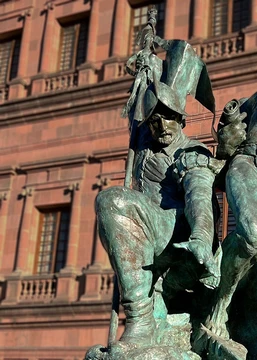
Zhang Qian
Han envoy whose journeys opened the Silk Road.
Zhang Qian, who died around 114 BC, was a diplomat, explorer, and politician for the Western Han dynasty in the late 2nd century BC. Serving under Emperor Wu, he became one of the earliest official envoys to gather detailed intelligence about Central Asia for the Han court—covering areas like the remnants of the Greco-Bactrian kingdom and the Parthian Empire. His journeys laid the groundwork for the Silk Road, which connected East and West and is often seen as an early step toward globalization.
Emperor Wu commissioned Zhang Qian to establish trade routes and secure political allies. His missions opened up exchanges between distant regions, introducing new goods and kingdoms to one another. The historian Sima Qian later compiled Zhang’s accounts in the 1st century BC. Around 114 BC, the Central Asian branches of the Silk Road were expanded largely because of Zhang’s explorations. Today, he is honored as a national hero in China for his role in opening the country—and the known world—to broader commercial and diplomatic opportunities.
Zhang Qian was born in Chenggu district, east of Hanzhong in Shaanxi province. He arrived in the capital, Chang’an (modern Xi’an), between 140 and 134 BC as a Gentleman serving Emperor Wu. At that time, the nomadic Xiongnu controlled Inner Mongolia and the Western Regions (Xiyu), blocking Han contact with distant lands. The emperor wanted to build trade ties but was stymied by Xiongnu hostility.
In 138 BC, the Han court sent Zhang Qian—a military officer familiar with the Xiongnu—to the Western Regions with a group of ninety-nine members. His goal was to forge an alliance with the Yuezhi against the Xiongnu. He was accompanied by a guide named Ganfu, a captured Xiongnu. To reach the Yuezhi in modern Tajikistan, Zhang had to cross Xiongnu territory, where he and Ganfu were captured and enslaved for thirteen years. During this time, Zhang married a Xiongnu woman, had a son, and earned the trust of the Xiongnu leader.
Eventually, Zhang, Ganfu, and Zhang’s family escaped. They traveled past Lop Nor, along the northern edge of the Tarim Basin, around the Kunlun Mountains, and through oasis fortresses in what is now Xinjiang, until they reached Dayuan and then the land of the Yuezhi. The Yuezhi were farmers who raised strong horses and grew crops like alfalfa, but they were too settled to fight the Xiongnu. Zhang spent a year amon
- born
- Chenggu district, Shaanxi, China
- died
- c. 114 BC
- field
- Diplomacy, exploration, politics
- nationality
- Chinese (Western Han dynasty)
- known_for
- Pioneering the Silk Road; missions to Central Asia; reports on Dayuan, Yuezhi, Daxia, and Anxi
Lore & Background
Zhang Qian was born in Chenggu district just east of Hanzhong in the north-central province of Shaanxi, China. He entered the capital, Chang'an, between 140 BC and 134 BC as a Gentleman, serving Emperor Wu of the Han dynasty. At the time the nomadic Xiongnu tribes controlled what is now Inner Mongolia and dominated the Western Regions. The Han emperor was interested in establishing commercial ties with distant lands but outside contact was prevented by the hostile Xiongnu. The Han court dispatched Zhang Qian, a military officer familiar with the Xiongnu, to the Western Regions in 138 BC with a group of ninety-nine members to make contact and build an alliance with the Yuezhi against the Xiongnu. He was accompanied by a guide named Ganfu, a Xiongnu who had been captured in war. However, to get to the territory of the Yuezhi he was forced to pass through land controlled by the Xiongnu who captured him and enslaved him for thirteen years. During this time he married a Xiongnu wife, who bore him a son, and gained the trust of the Xiongnu leader. Zhang and Ganfu eventually escaped and made their way to Dayuan and then to the land of the Yuezhi. The Yuezhi were too settled to desire war against the Xiongnu. Zhang spent a year in Yuezhi and adjacent Bactrian territory, documenting their cultures, before beginning his return trip. On his return he was again captured by the Xiongnu, who spared his life. Two years later the Xiongnu leader died and Zhang escaped. Of the original mission of just over a hundred men, only Zhang Qian and Ganfu returned to China in 125 BC.
Reader's Guide
Zhang Qian's significance lies in his pioneering role for the future Chinese conquest of lands west of Xinjiang and the creation of the Silk Road, which marked the beginning of globalization between east and west. His missions opened trade routes between East and West and exposed different products and kingdoms to each other through trade. Although he was unable to develop commercial ties between China and far-off lands on his first mission, his efforts eventually resulted in trade missions to the Wusun people in 119 BC, leading to trade between China and Persia. The Central Asian parts of the Silk Road routes were expanded around 114 BC largely through his missions and exploration. His accounts were compiled by Sima Qian in the 1st century BC in the 'Records of the Great Historian' (Shiji). Today, Zhang is considered a Chinese national hero for the key role he played in opening China and the countries of the known world to the wider opportunity of commercial trade and global alliances.
Did You Know?
- Zhang Qian was captured and enslaved by the Xiongnu for thirteen years, during which he married a Xiongnu wife and had a son.
- Of the original mission of over a hundred men, only Zhang Qian and his guide Ganfu returned to China.
- Zhang Qian was the first Chinese to write about one-humped dromedary camels, which he saw in the Yuezhi region.
- His reports included descriptions of the 'blood-sweating' Ferghana horses, which later led to Han military campaigns.
More in Explorers & Conquistadors 1-20
Spotted an error? Know more?
This is a living reference — every entry is fact-audited, and reader corrections feed straight into our audit queue. Suggest an edit · See this site's audit record